
When a Motorcycle Crash Takes a Life
Florida Wrongful Death Claims for the Rider’s Family
A fatal motorcycle crash leaves more than a wrecked bike and a police report. It can leave behind a spouse who lost a partner, children who lost a parent, parents who lost a son or daughter, and a family suddenly facing funeral expenses, lost income, and unanswered questions.
Under Florida law, a fatal motorcycle crash may give rise to a wrongful death claim when another person or company caused the rider’s death through negligence or another wrongful act. Florida’s Wrongful Death Act, Fla. Stat. §§ 768.16–.26, is designed to shift the losses resulting from a wrongful death from the survivors to the wrongdoer. See Martin v. United Sec. Servs., Inc., 314 So. 2d 765 (Fla. 1975).
When a Fatal Motorcycle Crash Becomes a Wrongful Death Case
A wrongful death claim may exist when a person’s death is caused by the “wrongful act, negligence, default, or breach of contract or warranty” of another, and the decedent could have maintained a claim had death not ensued. Fla. Stat. § 768.19.
In a motorcycle case, that may include:
- a driver who turns left into the rider’s path;
- a distracted or impaired driver;
- a driver who changes lanes without seeing the motorcycle;
- a commercial driver acting within the scope of work;
- a roadway hazard or negligent construction zone;
- a defective motorcycle part, tire, brake component, or repair; or
- a hit-and-run driver, if liability and available insurance can be established.
Who Files the Lawsuit?
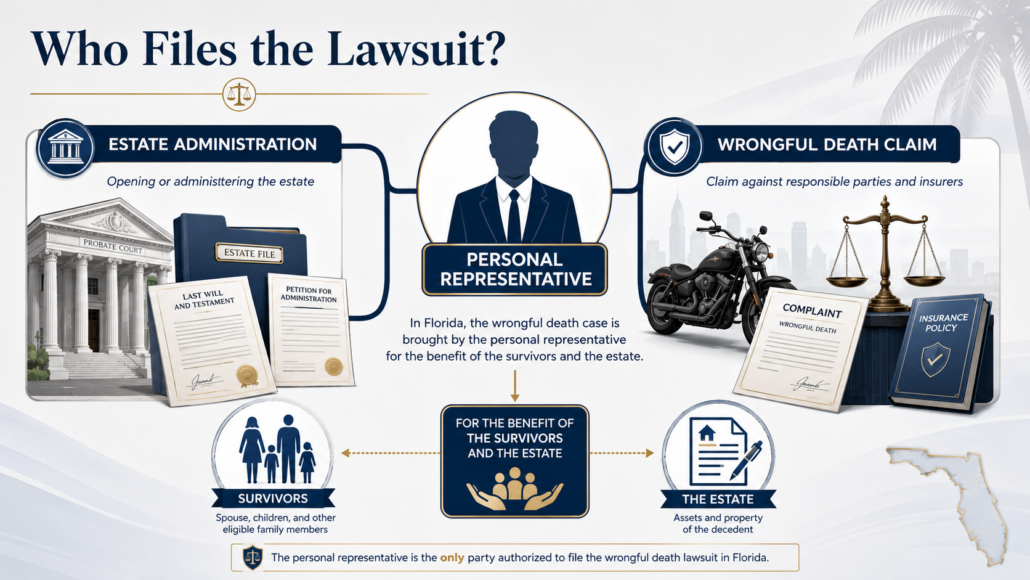
One of the most important points for families to understand is that Florida generally does not permit separate wrongful death lawsuits by each surviving relative.
Instead, the wrongful death action must be brought by the decedent’s personal representative, who recovers damages for the benefit of the survivors and the estate. Fla. Stat. § 768.20. The complaint must identify all potential beneficiaries and allege their relationship to the decedent. Fla. Stat. § 768.21.
That means a fatal motorcycle case often involves two parallel tracks:
- opening or administering the estate; and
- pursuing the wrongful death claim against the responsible parties and applicable insurers.
Who May Recover Damages?
Florida wrongful death damages are relationship-specific. The categories of damages available depend on who survived the rider and what losses the law recognizes. See Fla. Stat. § 768.21.
| Claimant | Potential Damages | Primary Authority |
|---|---|---|
| Surviving spouse | Lost support and services, loss of companionship and protection, and mental pain and suffering | Fla. Stat. § 768.21(1)–(2) |
| Minor children, and all children if there is no surviving spouse | Lost parental companionship, instruction, and guidance; mental pain and suffering; and in some cases lost support and services | Fla. Stat. § 768.21(1), § 768.21(3) |
| Parents | Mental pain and suffering for the death of a minor child, and for the death of an adult child if there are no other survivors | Fla. Stat. § 768.21(4) |
| Estate | Lost earnings from injury to death, medical or funeral expenses charged to the estate, and in qualifying cases loss of prospective net accumulations | Fla. Stat. § 768.21(6) |
Florida’s Wrongful Death Act also defines “minor children” in a way that often surprises families: for wrongful death purposes, the term generally means children under 25. Fla. Stat. § 768.18(2).
What the Estate May Recover
The estate’s claim is separate from the personal losses suffered by survivors. Depending on the facts, the personal representative may seek:
- lost earnings from the date of injury to the date of death;
- medical or funeral expenses charged to the estate; and
- loss of prospective net accumulations in qualifying cases.
See Fla. Stat. § 768.21(6).
In serious fatal motorcycle cases, proving these losses often requires more than tax returns and pay stubs. It may require employment records, business records, testimony from family members, and economic analysis concerning the rider’s earning capacity and likely future savings.
Motorcycle Wrongful Death Cases Are Commonly Defended on Comparative-Fault Grounds
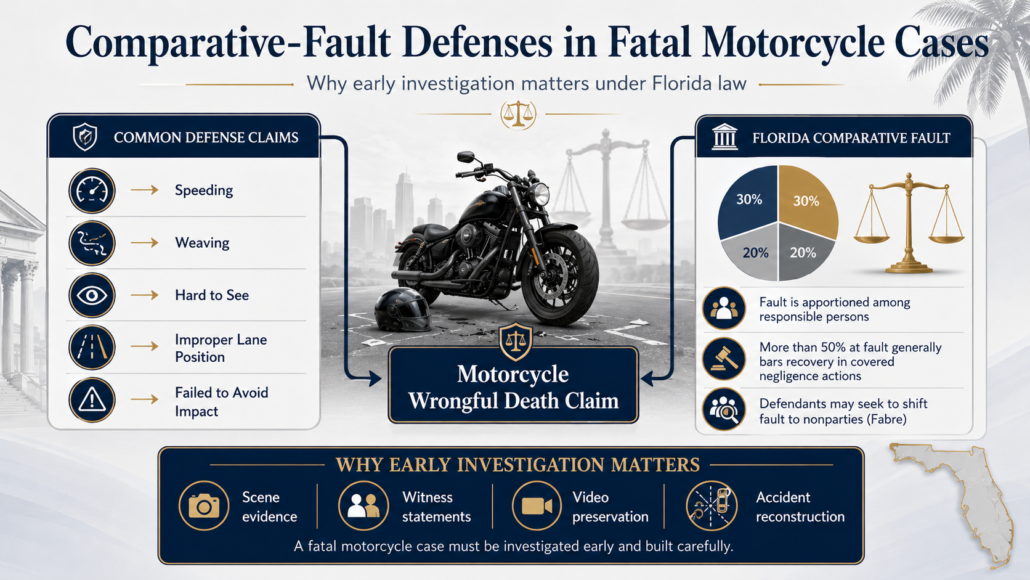
Motorcyclists are often blamed for crashes even when another driver caused them. After a fatal collision, the defense may argue that the rider was speeding, weaving, hard to see, improperly positioned, or failed to avoid the impact.
Those arguments matter because Florida applies comparative fault in negligence actions. Under current Fla. Stat. § 768.81, fault is apportioned, and a claimant found more than 50% at fault generally may not recover in covered negligence actions. Florida defendants also commonly seek to place fault on nonparties under the principles recognized in Fabre v. Marin, 623 So. 2d 1182 (Fla. 1993). In practice, that means a fatal motorcycle case must be investigated early and built carefully.
Evidence That Should Be Preserved Immediately
Motorcycle wrongful death cases are evidence cases. Important proof can disappear within days.
Evidence worth preserving may include:
- the motorcycle and all damaged components;
- the rider’s helmet, jacket, gloves, boots, and other gear;
- onboard video, helmet-cam footage, dash-cam footage, and cell phone video;
- photographs of the scene, skid marks, gouge marks, and debris fields;
- surveillance footage from nearby businesses or homes;
- traffic-camera footage;
- 911 calls and body-camera footage;
- witness statements;
- cell phone records of the at-fault driver, where appropriate;
- electronic data from involved vehicles;
- maintenance, inspection, and repair records; and
- roadway construction or hazard records, if road conditions played a role.
If the motorcycle is released, dismantled, repaired, sold, or destroyed too soon, key liability and product-condition evidence may be lost.
What If the Driver Had Little Insurance or Left the Scene?
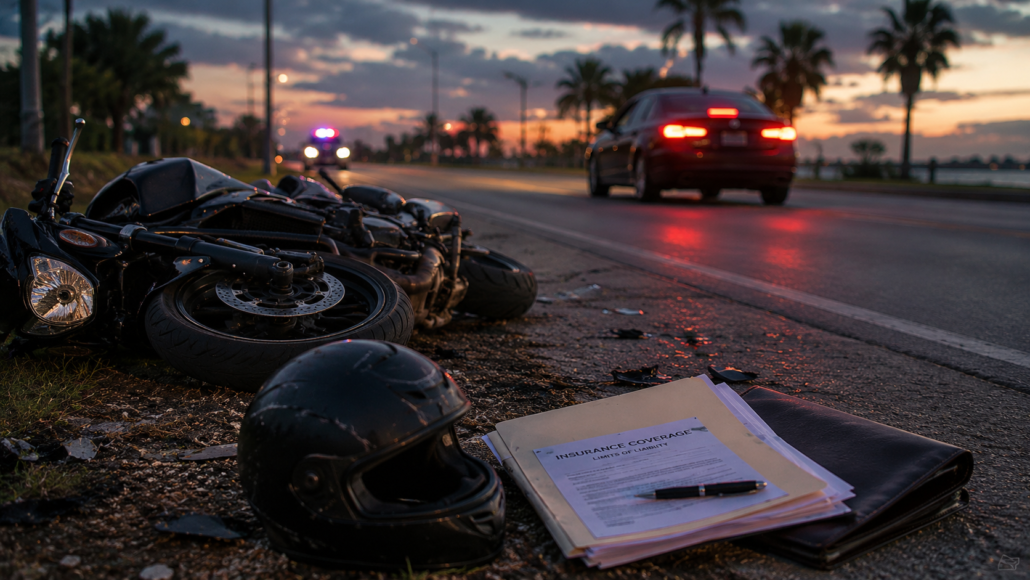
A fatal motorcycle crash can cause damages far beyond the limits of a typical auto policy. Even if the at-fault driver has minimal insurance, the investigation should not stop there.
Possible sources of recovery may include:
- the negligent driver’s bodily injury liability coverage;
- coverage available to the owner of the vehicle;
- commercial coverage if the driver was working;
- uninsured or underinsured motorist coverage;
- product-liability claims involving a defective motorcycle or component; and
- claims against other responsible entities, depending on the facts.
If the driver fled the scene, that conduct may also have criminal consequences. Leaving the scene of a crash involving death is a first-degree felony under Florida law. Fla. Stat. § 316.027(2)(c). But the civil case still depends on identifying the liable parties, preserving evidence, and locating applicable coverage.
What About Dangerous Road Conditions?
Not every fatal motorcycle crash is caused only by another driver. Some involve loose gravel, uneven pavement transitions, unmarked construction hazards, standing water, debris, or negligent roadway maintenance.
Those cases can be viable, but they are fact-intensive and time-sensitive. The condition must be documented quickly, because roads get repaired, resurfaced, or altered. When a public entity or contractor may be involved, the case also raises additional procedural and damages issues that should be evaluated early.
How Long Does the Family Have to File?
In Florida, a wrongful death action is generally subject to a two-year statute of limitations. Fla. Stat. § 95.11. That is the outside deadline in most cases, not a reason to wait.
In a fatal motorcycle case, delay can be costly. Video may be overwritten. Vehicles may be destroyed. witnesses may become difficult to locate. Insurance defenses may take shape before the family has a full picture of what happened.
The Bottom Line
A wrongful death claim after a fatal motorcycle crash is about more than an insurance file. It is about accountability, preserving evidence, identifying every available source of recovery, and presenting the full measure of the family’s loss under Florida law.
When another person’s negligence takes a rider’s life, the family should act quickly to protect the motorcycle, the evidence, and the claim.
Speak With a Florida Motorcycle Wrongful Death Attorney
If your family lost a loved one in a fatal motorcycle crash in Fort Lauderdale, Broward County, Miami-Dade County, Palm Beach County, or elsewhere in Florida, early legal investigation matters. The personal representative, the estate, the available insurance, and the evidence all need immediate attention.
Attorney Gabriel J. Carrera represents families in serious and fatal motorcycle cases throughout Florida.
This article is for general informational purposes only and does not create an attorney-client relationship. Every wrongful death claim depends on its facts, the available evidence, the applicable insurance coverage, and Florida law.

