
The Helmet Defense Sucks!
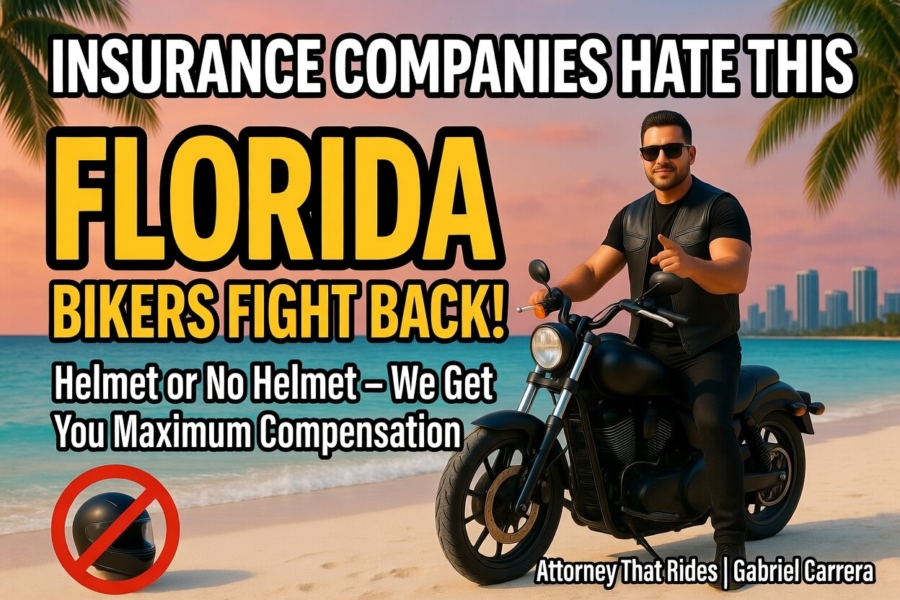
How Insurance Companies Try to Slash Motorcycle Claims in Florida?
Helmet Defense Sucks, that is something that insurance companies have been using to cut motorcycle claims in Florida and this post clarifies what riders can do to protect their rights after a crash.
For the last 19 years, I have represented injured motorcyclists across South Florida. I ride these same roads, I know the tactics insurance companies use, and I know how they try to turn Florida’s helmet law into a weapon against riders. The truth is simple: Florida law allows many adult riders to ride without a helmet, and that lawful choice does not automatically defeat a motorcycle injury claim.
If you were hurt in a Miami motorcycle crash, the focus should be on who caused the wreck and what damages you suffered. Florida’s helmet law may come up, but it is not a free pass for an insurance company to deny responsibility. In the right case, the defense must still prove that helmet nonuse caused or worsened the specific injuries at issue.
If you or a loved one has been injured in a motorcycle accident in Miami, Fort Lauderdale, or anywhere in South Florida, call me directly at 954-533-7593. I offer a free consultation, and I work on contingency.
Florida’s Partial Helmet Law
Florida does not require every motorcyclist to wear a helmet. Under Fla. Stat. § 316.211, the law is age-based and coverage-based.
In general:
- Riders under 21 must wear protective headgear.
- Riders 21 and older may ride without a helmet if they have at least $10,000 in medical benefits coverage.
- Eye protection is generally required.
- A violation is treated as a noncriminal traffic infraction.[1]
Florida also requires a motorcycle endorsement under Fla. Stat. § 322.03 to operate a motorcycle legally. If a rider does not have the proper endorsement, insurers may try to use that fact to attack the claim, even though it does not automatically bar recovery.
Pro-Rider Tip
If you lawfully ride without a helmet, keep proof of your required medical benefits coverage. It may matter later if the insurance company tries to argue you were somehow at fault just for riding helmet-free.
How the Helmet Defense Works
Insurance companies often raise what is commonly called the “helmet defense.” Their argument is that if you were not wearing a helmet, your injuries must be partly your fault, so your compensation should be reduced.
That is not the end of the story.
Florida courts have long required a real causal connection between helmet nonuse and the particular injuries claimed. In Rex Utilities, Inc. v. Gaddy, 413 So. 2d 1232 (Fla. 3d DCA 1982), the Third District held that helmet evidence is not admissible unless the defense can show both negligence in failing to wear the helmet and that the lack of a helmet proximately caused the injuries at issue.
Put differently: the defense cannot simply point to a bare head and demand a discount. It must prove that a helmet would have prevented or reduced the specific injuries claimed.
That matters because many motorcycle injuries have nothing to do with helmet use at all, including:
- leg fractures,
- spinal injuries,
- shoulder and arm trauma,
- internal injuries,
- road rash, and
- other impact-related harm.
When the defense cannot tie helmet nonuse to the actual injury pattern, the helmet defense often loses force.
Comparative Negligence in Florida
Florida now follows a modified comparative negligence system under Fla. Stat. § 768.81. In practical terms, if a plaintiff is found more than 50 percent at fault for the crash, recovery may be barred. But helmet nonuse is usually a damages issue, not the issue of who caused the collision.
That distinction is important.
The real question is usually whether the other driver caused the crash in the first place.
In many motorcycle cases, the at-fault driver was:
- making an unsafe left turn,
- failing to yield,
- following too closely,
- turning without seeing the motorcycle, or
- driving distracted.
The helmet issue should not become a backdoor way to avoid liability for causing the wreck.
Why the Helmet Issue Often Fails in Serious Injury Cases
The helmet defense is only as strong as the evidence supporting it. If the injuries are unrelated to head protection, or if medical causation is speculative, the defense can struggle.
In a serious case, the analysis usually requires:
- crash reconstruction,
- medical expert testimony,
- biomechanical evidence, and
- a careful review of the mechanism of injury.
If the defense cannot show that a helmet would have changed the outcome, the argument may not meaningfully reduce the case value.
What Riders Should Do After a Miami Motorcycle Crash
If you are involved in a crash, take these steps as soon as possible:
- Get medical attention immediately.
- Take photos of the scene, vehicles, injuries, and road conditions.
- Obtain the crash report.
- Do not give a recorded statement to the insurance company before speaking with counsel.
- Keep all medical records and bills.
- Document lost wages and missed work.
- Avoid social media posts about the crash or your injuries.
These steps can help preserve evidence and protect your claim.
Frequently Asked Questions
Can I still file a claim if I was not wearing a helmet?
Yes. Lawful nonuse of a helmet under Fla. Stat. § 316.211 does not automatically bar a claim. The defense still has to prove causation under Rex Utilities, Inc. v. Gaddy, 413 So. 2d 1232 (Fla. 3d DCA 1982).[1]
Does not wearing a helmet automatically reduce my recovery?
No. The insurance company must show that the lack of a helmet actually caused or worsened the injuries for which you seek compensation.
Do I need a motorcycle endorsement?
Yes. Florida generally requires a motorcycle endorsement under Fla. Stat. § 322.03. Riding without one can create an additional issue for the defense to raise.[1]
Is the other driver usually at fault in motorcycle crashes?
Often yes, but every case depends on the facts and evidence. The key is proving liability with scene evidence, witness testimony, and expert analysis.
The Attorney That Rides Has Your Back
Florida gives adult riders the freedom to ride without a helmet in certain circumstances. That freedom should not disappear just because another driver caused a crash.
The helmet defense is a common insurance tactic, but it is not automatic, and it is not unbeatable. With the right evidence and the right strategy, injured riders can pursue full and fair compensation.
If you have been hurt in a motorcycle crash in Miami, Fort Lauderdale, or anywhere in South Florida, call Attorney Gabriel Carrera, The Attorney That Rides, at 954-533-7593 or visit AttorneyThatRides.com. Your consultation is free, and you pay nothing unless there is a recovery.
Ride safe. Ride free. And when you need me, I am here.

