

When Can USCIS Delays Be Challenged in Federal Court?

Every year, thousands of immigrants and their families face long delays while waiting for U.S. Citizenship and Immigration Services, or USCIS, to decide pending applications and petitions. Some processing time is normal. But at a certain point, a delay may become legally unreasonable.
When that happens, federal court may provide a path forward. In some cases, applicants can ask a federal judge to require USCIS to make a decision.
Importantly, these lawsuits do not ask the court to approve the immigration benefit. They ask the court to require the agency to do its job and adjudicate the case.
Understanding USCIS Processing Delays
USCIS handles millions of immigration applications every year, including adjustment of status applications, naturalization applications, employment authorization requests, family-based petitions, waivers, humanitarian filings, and asylum-related applications.
Processing times vary depending on the type of case, the applicant’s background, the office handling the matter, and the agency’s overall workload.
A delay by itself does not automatically create a legal claim. The key question is whether the delay has become unreasonable under federal law.
What Is a Mandamus Lawsuit?
One of the most common tools used to challenge USCIS delays is a petition for a writ of mandamus.
A writ of mandamus is a federal court action asking a judge to compel a government agency to perform a legally required duty. In immigration cases, that usually means asking the court to require USCIS to make a decision on a pending application.
To succeed, the applicant generally must show that the application was properly filed, that USCIS has a duty to process and decide it, that no other adequate remedy exists, and that the delay has become unreasonable.[1]
A mandamus case does not ask the judge to approve the case. It only seeks an order requiring USCIS to adjudicate the application. In many cases, USCIS acts after the lawsuit is filed and before the court ever rules.
The Administrative Procedure Act
Many USCIS delay cases also rely on the Administrative Procedure Act, or APA.
The APA allows federal courts to review agency action that has been unlawfully withheld or unreasonably delayed.[2] Federal law further provides that agencies must conclude matters presented to them within a reasonable time.[3]
For that reason, many immigration delay lawsuits are filed under both the APA and the Mandamus Act. In practice, the APA is often the stronger framework because it directly addresses agency inaction.
How Long Is Too Long?

There is no universal rule establishing when a delay becomes unreasonable. Federal courts look at the facts of each case, including the type of application, the complexity of the file, the length of the delay, whether background checks or security screenings are pending, the impact on the applicant, and the government’s explanation for the delay.[4]
A six-month delay may be routine in one case and unreasonable in another. On the other hand, delays lasting years often receive much closer scrutiny.
Common Situations That May Justify Federal Court Intervention
Federal litigation may be appropriate when an adjustment of status case stalls for years after an interview or after all requested evidence has been submitted, and USCIS gives no meaningful explanation for the delay.
It may also be appropriate when a work permit delay causes serious financial hardship, when a naturalization case remains pending long after the interview, or when a waiver application stays unresolved for an extended period.
In each of these situations, the real issue is whether the delay has crossed the line from ordinary processing to legally unreasonable inaction.
What Federal Courts Will Not Do
Many applicants misunderstand the purpose of a delay lawsuit.
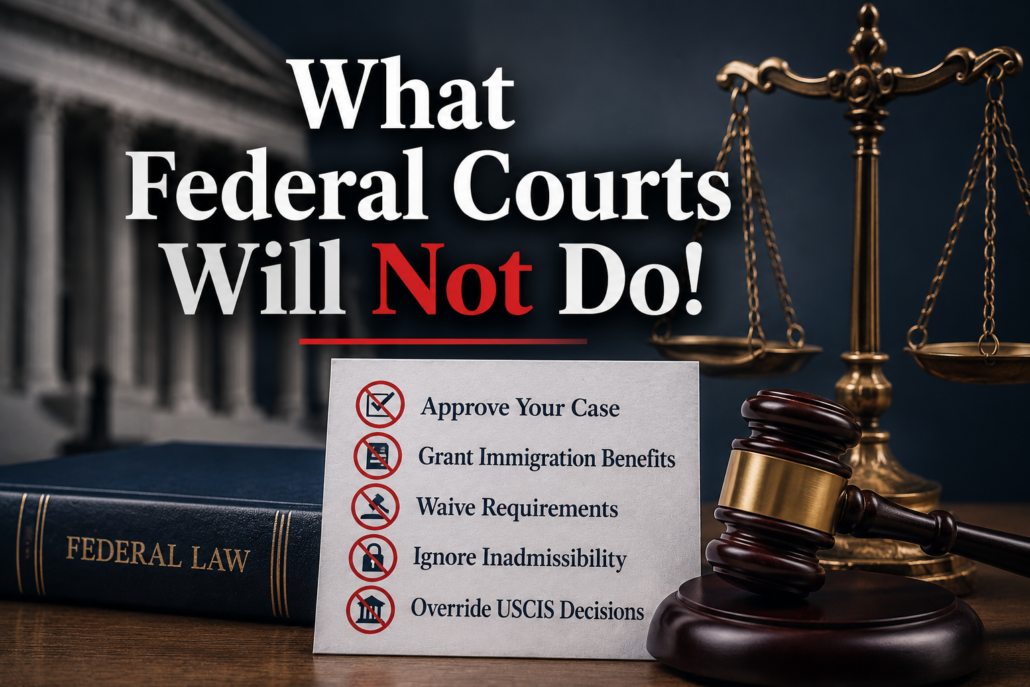
Federal courts generally will not approve a green card application, grant citizenship, waive statutory requirements, ignore inadmissibility grounds, or substitute their judgment for USCIS on a discretionary immigration decision.[5]
Instead, the court’s role is usually limited to deciding whether the agency has unlawfully failed to act. If the lawsuit succeeds, USCIS is typically ordered to make a decision. That decision may be approval or denial.
Advantages of Filing a Federal Lawsuit
A properly filed federal case can force government counsel to review the file, bring attention to a case that has been sitting idle, obtain an explanation for the delay, and sometimes lead to action soon after the government is served.
In many delay cases, USCIS resolves the matter after litigation is filed, which is often the practical goal of the case.
Risks and Considerations
Federal litigation is not appropriate in every case.
Before filing suit, counsel should evaluate current USCIS processing times, the type of benefit requested, the strengths and weaknesses of the underlying application, whether a request for evidence is likely, and whether forcing a decision could create immigration consequences.
In some cases, pushing for a decision too early may not be in the client’s best interest.
Why Experienced Counsel Matters

Federal immigration litigation combines immigration law, federal civil procedure, and administrative law. A successful case requires more than showing that the application has been pending for a long time. The attorney must show that the delay has become unreasonable and that the agency has a duty to act.[6]
Each case is different, and the decision to file in federal court should be based on a careful review of the facts, the procedural history, and the potential risks.
Conclusion
USCIS delays can be frustrating, costly, and disruptive. While some waiting is unavoidable, applicants are not always required to wait indefinitely.
When a delay becomes unreasonable, federal court may provide an effective way to compel USCIS to act. Through a mandamus action, an APA claim, or both, applicants may be able to obtain the decision they have been waiting months or even years to receive.
If your immigration application has been pending far beyond normal processing times, speaking with experienced federal immigration counsel may help determine whether a court challenge is appropriate.

